Pakistan's Defence Minister Khawaja Asif has claimed that Islamabad has seen a record surge in orders for Chinese-origin JF-17 Thunder jets following the May 2025 military conflict with India and that it may not need bailouts from IMF after six month
Pakistan's Defence Minister Khawaja Asif has claimed that Islamabad has seen a record surge in orders for Chinese-origin JF-17 Thunder jets following the May 2025 military conflict with India and that it may not need bailouts from the International Monetary Fund (IMF) after six months. The remarks came months after Pakistan was forced to sell its flag carrier, Pakistan International Airlines (PIA), because of an IMF condition.
"Our aircraft have been tested, and we are receiving so many orders that Pakistan may not need the International Monetary Fund in six months," Asif told broadcaster Geo News.
Pakistan's Dependence On IMF
Pakistan is currently under a $7 billion IMF programme, its 24th, which followed a short-term $3 billion deal that helped avert a sovereign default in 2023. It secured the Fund's support after Saudi Arabia and other Gulf allies provided financial and deposit rollovers.
These loans are subject to strict conditions, including fiscal reforms, subsidy cutbacks, and revenue-generating initiatives that Pakistan must implement to receive loans.
ALSO READ: Bangladesh Interested In Procuring JF-17 Jets Developed With China: Pakistan
Surge In JF-17 Orders
Pakistan has in recent months stepped up defence outreach as it seeks to expand arms exports and monetise its domestic defence industry. The JF-17s have become the cornerstone of the Pakistani military's weapons development programme, figuring in a deal with Azerbaijan and a $4-billion weapons pact with the Libyan National Army-- one of the country's largest-ever arms sales.
Islamabad has also held talks with Bangladesh on the possible sale of JF-17s, as it widens its arms supply ambitions beyond South Asia and the Middle East.
Per a Reuters report, Islamabad is also in talks with Saudi Arabia to convert about $2 billion of Saudi loans into a JF-17 fighter jet deal, deepening military cooperation between the two Islamic nations months after they signed a mutual defence pact last year.
The talks underscore how the two allies are moving to operationalise defence cooperation at a time when Pakistan is facing acute financial strain and Saudi Arabia is reshaping its security partnerships to hedge against uncertainty about US commitments in the Middle East.
Amir Masood, a retired air marshal and analyst, told Reuters that Pakistan was in talks about or had finalised deals with six countries to provide equipment, including JF-17s, electronic systems and weapons systems for the jets.
The JF-17's marketability has been increased because "it is tested and has been used in combat," he claimed, adding that it's also cost-effective.
ALSO READ: Bangladesh Interested In Procuring JF-17 Jets Developed With China: Pakistan
Will Pak's Plan Be Successful
Reacting to Aif's claim, Pakistani political scientist-author Ayesha Siddiqa said the Pakistani minister was "sounding like a lot of journalists that claim to cover defence -- simply can't tell the back of a plane and a submarine from its front," according to an India Today report.
She claimed that after production, Pakistan is not left with enough money that could rescue Pakistan from IMF loans.
ALSO READ: JF-17, Mirage, Drones: India's Plan Behind Choosing Pak Air Force Targets
Pak's Tall Claim About JF-17
Pakistan has said the JF-17 aircraft was deployed during its conflict with India in May last year, the heaviest fighting between the two nuclear-armed neighbours in decades. But the Pakistan Air Force (PAF) reportedly lost between six and nine fighter jets, two high-value surveillance aircraft, over ten armed drones, and a C-130 Hercules transport aircraft in Operation Sindoor, India's retaliatory military action following the Pahalgam terror attack in Jammu and Kashmir, which claimed 26 lives.
According to sources, a post-conflict assessment of the military engagement in early May has revealed heavy damage to Pakistani aerial and ground military assets. They said between six and nine PAF fighter jets were downed during aerial operations.
The downing of these jets, according to sources, was confirmed via radar tracking and thermal signatures captured by Indian ground-based missile systems and airborne early warning assets. The Pakistani aircraft vanished from tracking grids after impact confirmations, sources said.
Moreover, nearly 20 per cent of PAF infrastructure across 11 air bases also suffered extensive damage, crippling Islamabad's critical assets such as Saab 2000 AWACS and TPS-43J radar systems.
About JF-17 Thunder
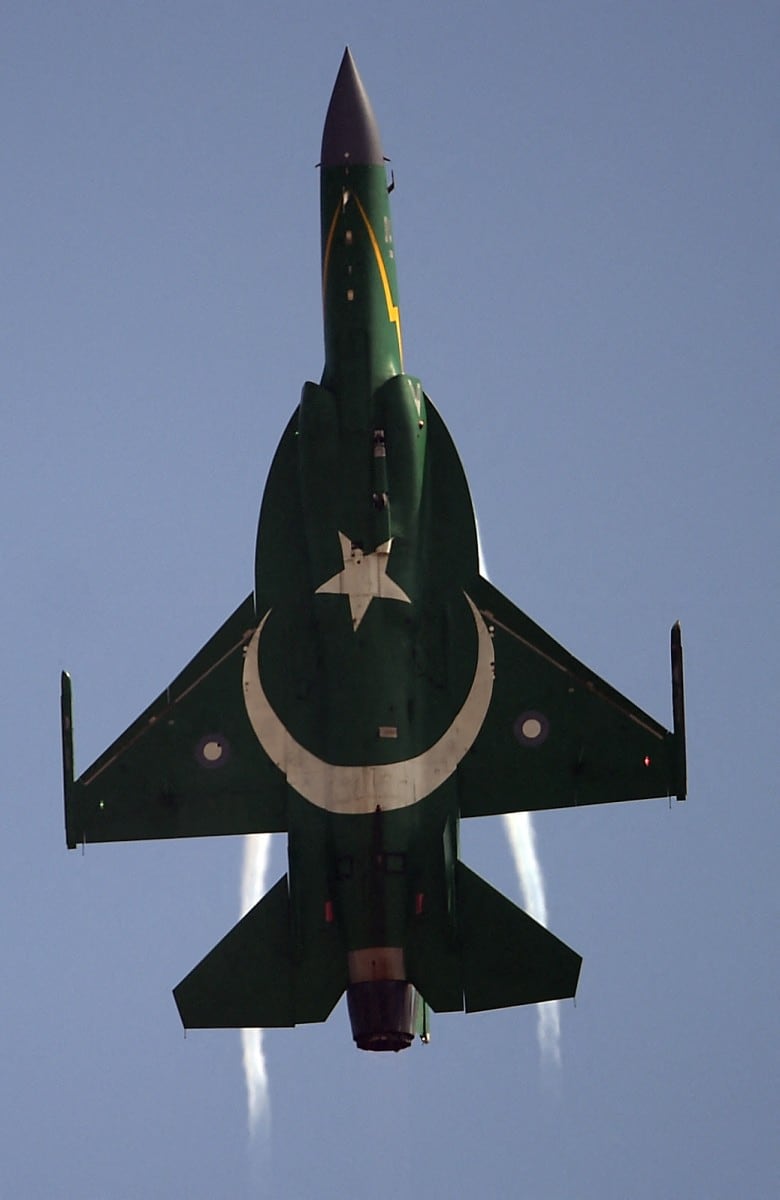
The JF-17 Thunder is a lightweight, all-weather, multi-role fighter aircraft jointly manufactured by the Pakistan Aeronautical Complex (PAC) and China's Chengdu Aircraft Corporation (CAC) under an agreement signed between Beijing and Islamabad in the 1990s.
The two nations began the joint production in the early 2000s at the PAC facility in Kamra, situated in Pakistan's Punjab province, just more than 80 km (50 miles) away from Islamabad.
According to a report by Al Jazeera, production is split between the two countries, with 58 per cent carried out in Pakistan and 42 per cent in China.
"We are manufacturing the front fuselage and vertical tail, whereas China makes the middle and rear fuselage of the plane, with a Russian engine being used, as well as British manufacturer Martin Baker's seats being installed. However, the complete assembly of the plane is carried out in Pakistan," the publication reported, quoting a retired Pakistan Air Force air commodore who worked closely on the programme.
Estimates place the JF-17's unit cost at between $25m and $30m.