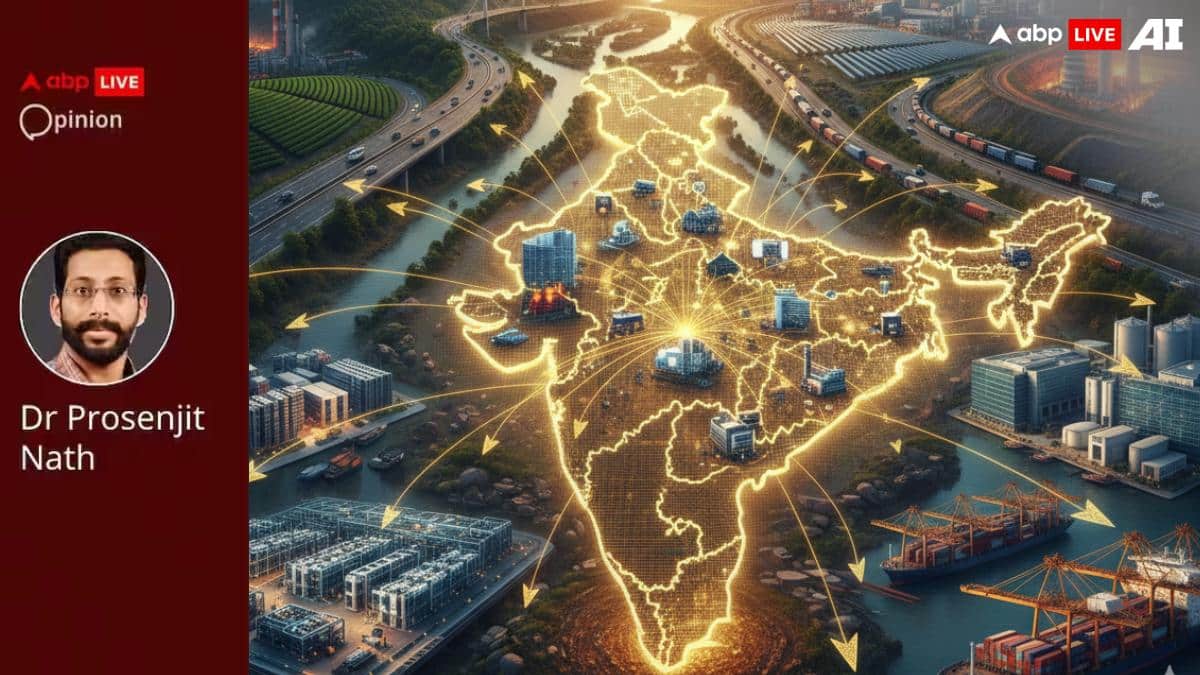
For years, critics of India’s economic trajectory have argued that growth under the current political dispensation has been uneven, limited to a few urbanised, industrially advanced states, while the rest of the country lags behind. Recent data from the Reserve Bank of India (RBI) on Gross State Domestic Product (GSDP) at constant prices decisively dismantles this narrative. The numbers tell a different story: India’s economic expansion over the past five years has been broad-based, state-driven, and geographically diverse.
Between FY20 and FY25, India’s real GDP rose from Rs 145.35 lakh crore to Rs 187.97 lakh crore, an increase of nearly 29 per cent despite unprecedented global disruptions such as the COVID-19 pandemic, geopolitical instability, and inflationary pressures. More significantly, the top ten fastest-growing major state economies outpaced the national average, with growth ranging from 30 per cent to an impressive 45 per cent. This is not the picture of a lopsided economy; it is the signature of a resilient, federal growth model.
Assam Leads
At the top of the list is Assam, which emerged as India’s fastest-growing state economy with a remarkable 45 per cent expansion. Its GSDP rose from Rs 2.4 lakh crore in FY20 to Rs 3.5 lakh crore in FY25. Long dismissed by Delhi-centric analysts as a “peripheral” economy, Assam’s performance underscores the impact of sustained infrastructure investment, improved connectivity, and focused attention on the Northeast. Agriculture, oil and gas, and public capital expenditure, particularly in roads, bridges, and logistics, have transformed Assam into a growth engine rather than a subsidy-dependent state.
Tamil Nadu, often cited as a legacy manufacturing hub, ranked second with 39 per cent growth, as its GSDP expanded from Rs 12.4 lakh crore to Rs 17.3 lakh crore. The state’s diversified industrial base, spanning automobiles, electronics, textiles, and services, has benefited from policy stability and India’s broader push toward manufacturing self-reliance. Its performance also refutes the claim that only politically aligned states prosper under the Centre’s economic framework.
Karnataka followed closely with 36 per cent growth, driven by its strengths in technology services, startups, biotechnology, and advanced manufacturing. Its GSDP rose from Rs 11.5 lakh crore to Rs 15.7 lakh crore, reinforcing the role of innovation-led ecosystems in sustaining long-term growth.
UP's Political Sway
Perhaps the most politically consequential data point is Uttar Pradesh’s 35 per cent growth over five years. Often portrayed as economically backwards, India’s most populous state saw its GSDP increase from Rs 11.7 lakh crore to Rs 15.8 lakh crore. A large domestic market, agricultural reforms, improved law and order, and rapid expansion of industrial corridors and logistics infrastructure have begun to change UP’s economic profile. Growth here is particularly important because it reflects economic inclusion at scale.
Rajasthan recorded 34 per cent growth, with its economy expanding from Rs 6.8 lakh crore to Rs 9.1 lakh crore. Mining, renewable energy, tourism, and cement production have played a major role, showing how resource-rich states can leverage both traditional and green sectors simultaneously.
Bihar and Andhra Pradesh each posted 33 per cent growth, another data point that challenges entrenched assumptions. Bihar’s economy grew from Rs 4.0 lakh crore to Rs 5.3 lakh crore, largely driven by agriculture and services, while Andhra Pradesh expanded from Rs 6.5 lakh crore to Rs 8.7 lakh crore on the back of agriculture, ports, logistics, and food processing. These gains underline the importance of rural demand and coastal infrastructure in India’s growth story.
Chhattisgarh and Jharkhand, often clubbed together as mineral-dependent states, each recorded 31 per cent growth. Chhattisgarh’s GSDP rose from Rs 2.5 lakh crore to Rs 3.3 lakh crore, supported by mining, power generation, and steel, while Jharkhand’s economy grew from Rs 2.3 lakh crore to Rs 3.0 lakh crore, anchored by minerals and heavy industry. These states illustrate how industrial fundamentals continue to matter in a service-heavy economy.
Telangana rounded out the top ten with 30 per cent growth, as its GSDP increased from Rs 6.4 lakh crore to Rs 8.4 lakh crore. IT, pharmaceuticals, and urban services remain its backbone, benefiting from both global demand and domestic consumption.
Not Accidental
Taken together, the RBI’s GSDP data exposes the hollowness of claims that India’s growth is narrow or exclusionary. From the Northeast to the heartland, from mineral belts to technology hubs, states across political and geographic lines are expanding faster than the national average.
This is not accidental; it is the outcome of a macroeconomic framework that prioritises infrastructure, fiscal discipline, and cooperative federalism. India’s economic rise, far from being confined to a few enclaves, is being written across its states one growth story at a time.
(The writer is a technocrat, political analyst, and author)
Disclaimer: The opinions, beliefs, and views expressed by the various authors and forum participants on this website are personal and do not reflect the opinions, beliefs, and views of ABP Network Pvt. Ltd.