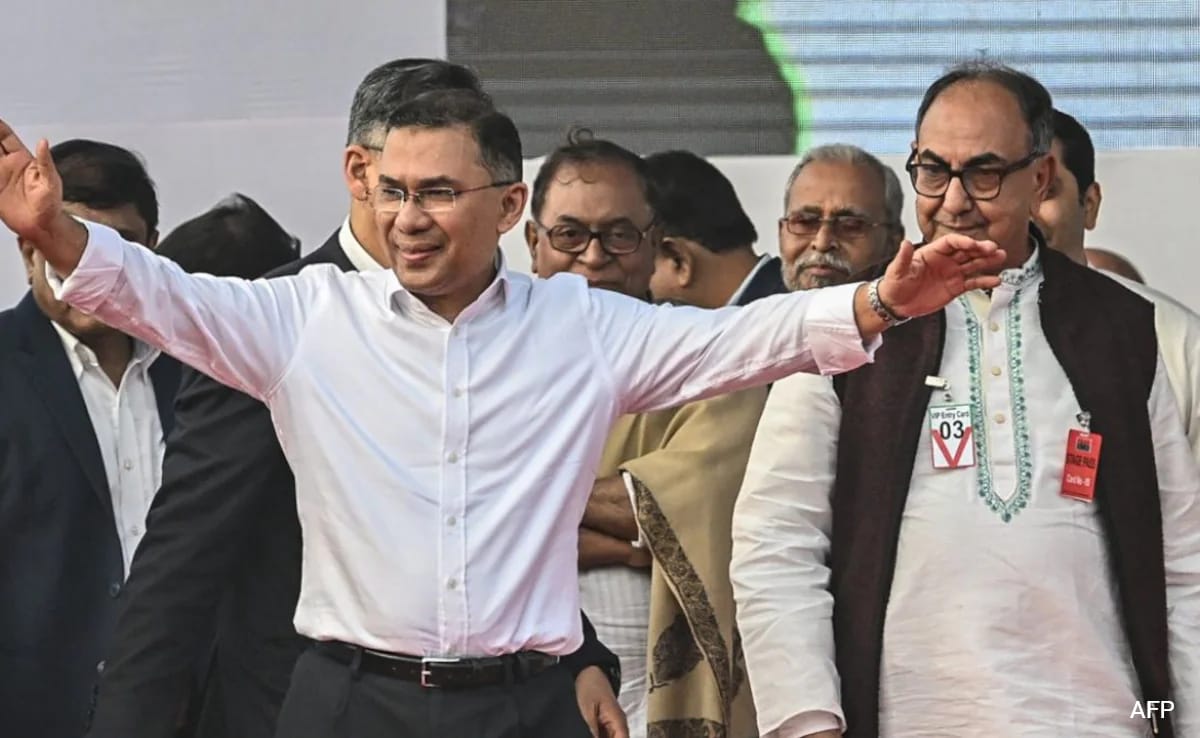
Tarique Rahman's return to Dhaka on Christmas Day, and now the passing away of his mother, Begum Khaleda Zia, have placed the BNP in pole position to win the forthcoming general elections in Bangladesh in February next year.
The baton has passed. Bangladesh's first woman Prime Minister, Begum Khaleda Zia, breathed her last this morning in Dhaka. Her legacy includes keeping the Bangladesh Nationalist Party (BNP) firmly together, even strengthening it, after the death of her husband, President Ziaur Rahman. She will be remembered for joining hands with Sheikh Hasina in bringing a peaceful end to President Hussain Muhammad Ershad's dictatorship and ensuring Bangladesh's return to democracy through the 1991 elections, which she won. Relations with India under the BNP rule have never been comfortable, and the legacy of BNP's strong links with Pakistan and with Jamaat-e-Islami has a lot to do with this.
On the face of it, Tarique Rahman's return to Dhaka on Christmas Day 2025, and now the passing away of his mother, Begum Khaleda Zia, have placed the BNP in pole position to win the forthcoming general elections in Bangladesh, scheduled for February next year. However, it is important not to get carried away by the media hype generated by print, electronic and social media outlets, most of which are thoroughly controlled and managed by the Yunus regime.
The BNP And the Jamaat
The BNP and the Jamaat-e-Islami have been political allies for a quarter century, since 2001. Their ideological alliance is far older, going back to their shared support for the tenets and values that sided with Pakistan and opposed everything that the 1971 Liberation War stood for. The constitution of Bangladesh, adopted in 1972 under Sheikh Mujibur Rahman, had, as its four pillars, the principles of democracy, secularism, socialism and nationalism. In addition, Sheikh Mujib banned religion-based political parties and revoked the citizenship of Ghulam Azam, the Ameer of Jamaat-e-Islami during the Liberation War, responsible for untold war crimes against the minorities, against women, against intellectuals and all those supporting the Awami League. Under President Zia (who seized control after the assassination of Sheikh Mujib and later founded the BNP), all these provisions were reversed. Ghulam Azam returned to Dhaka on a Pakistani passport in August 1978, during the military rule of General Zia. The ban on religion-based political parties was reversed, and a special “Citizenship Act” enacted in 1978 provided the legal framework for Ghulam Azam to eventually regain his Bangladeshi citizenship through a court order in 1994 (when Begum Khaleda Zia was Prime Minister) after a long legal battle.
It was under President Zia (father of Tarique Rahman) that the Constitution of Bangladesh was amended to replace the word secularism with the phrase that “absolute trust and faith in the Almighty Allah shall be the basis for all actions”, thereby legitimising political Islam. Today, the BNP does have a moderate faction. This group has fought hard for early elections in Bangladesh, resulting in the Yunus regime being forced to declare the dates of February 2026 after their initially declared plan (supported by Jamaat-e-Islami) of no elections for four years, and elections only after completion of the so-called “reform process”. The moderate group within the BNP also opposed the ban on the activities of the Awami League (imposed by the Yunus regime in May 2025) and supported the Awami League's participation in the February 2026 elections. However, this faction's position within the BNP is weak, and they are inevitably overruled by the much stronger pro-Jamaat-e-Islami faction. It is estimated that more than half the BNP membership is pro-Jamaat.
Tarique's Closeness To The Jamaat
Tarique Rahman has almost always been associated with the pro-Jamaat faction of the BNP. He has been politically active since the late 1980s but came into prominence during his mother Begum Khaleda Zia's second term as Prime Minister, from 2001 to 2006, when the Jamaat-e-Islami was the principal alliance partner. During these years, Tarique ran Hawa Bhaban, the power centre recognised as the de facto PMO. His involvement in directing/coordinating the Chittagong Arms Haul (April 2004), and equally in the grenade attack on Sheikh Hasina's political rally in Dhaka (August 2004), has been written about extensively. However, what often escapes attention is the close involvement of Pakistan in the planning of each of these incidents, including participation in meetings with Tarique Rahman in Dhaka and overseas. These were highlighted during the separate hearings (for each of these two incidents) in the legal trials held in Dhaka after 2009. During Begum Khaleda Zia's second term (2001-06), Pakistan's activities in Bangladesh were at an all-time high, not seen since the 1971 Liberation War.
Tarique Rahman's closeness to the Jamaat-e-Islami and to Pakistan (said to be through the ISI) has continued through the 17 years' exile spent in London (2008-25), including in the planning and execution of the regime-change operation of July/ August 2024. That is why the elections of February 2026, if held without the participation of the Awami League, with BNP and the Jamaat-e-Islami as the principal contenders, can only be described as a 'friendly fight' with a pre-determined outcome.
Islamists Have The Upper Hand
For the February elections, the Jamaat-e-Islami has formed a ten-party alliance bringing together all the Islamist parties of Bangladesh. The most recent addition, bringing this group to ten, has been the students' party, the NCP (National Citizens' Party), formed by the ‘student leaders' of the regime-change operation, an embarrassing admission of their shared ideological leanings. Most observers in Bangladesh give credence to the results of the survey conducted during the period September 13-October 12, 2025, by the US's International Republican Institute (IRI), ubiquitous and very active in Bangladesh. The IRI survey concluded that of those questioned, the BNP was favoured by 33%, while the Jamaat by 29%. The race seems to be a close one - perhaps too close to call. However, if one adds to the Jamaat tally, the 5% vote the survey assigns to the Islami Andolan Bangladesh, and the 6% vote in favour of the NCP, then the Islamist parties already have the upper hand.
As expected, the IRI survey strongly favours a post-election government led by the Jamaat. Should this come to pass, the pro-Jamaat faction of the BNP will be accommodated in the government. And if the BNP gets more seats than the Jamaat, the formula said to have been finalised between Mohd Yunus and Tarique Rahman in London in June 2025 envisages the former as the President of Bangladesh, with Rahman as Prime Minister and the Ameer of Jamaat-e-Islami as the Deputy Prime Minister. Each of these options would give Pakistan every opportunity to continue with the central role it has already created for itself in taking Bangladesh back to the pre-1971 command-and-control relationship it enjoyed with the then East Pakistan.
India's Concerns
India has repeatedly and strongly spoken in favour of free, fair and inclusive elections in Bangladesh. The Awami League, the Jatiya Party and others must be allowed to contest on an equal footing with the BNP and the Jamaat. Without this, the election results will be rejected by the people of Bangladesh, and the present lawlessness, violence, and brutalities against minorities will continue. So far, Tarique Rahman has not said a word in condemnation of the eighteen-month-long unrelenting violence against minorities, not even on the bestial lynching of Dipu Chandra Das. The minorities, on their part, have never forgotten the 2001 post-election violence unleashed against them by the Khaleda Zia regime.
Sheikh Hasina has mourned the death of Begum Khaleda Zia, describing it as an ‘Irreparable loss'. It will be a fitting tribute to the legacy of Begum Khaleda Zia if the February elections are allowed to be free, fair and inclusive, with the participation of Awami League, Jatiya Party and others. There is no legitimacy to the ban imposed on the participation of the Awami League. Through his eulogy of the slain Osman Sharif Hadi, Chief Adviser Mohd Yunus has shown himself to be completely partisan. The need of the hour is to have a new caretaker government, which will then ensure free, fair, inclusive, and, therefore, credible elections in Bangladesh.
(The author is a former High Commissioner of India to Bangladesh. Currently, she's the Founding Trustee & Convener of the
South Asia Women's Network)
Disclaimer: These are the personal opinions of the author