Welcome to DailyAdda News (“we”, “our”, “us”). By downloading, accessing, or using the DailyAdda News mobile app or website, you agree to the following Terms & Conditions. Please read them carefully.
🔹 1. Use of the App
DailyAdda News provides:
Bengali, Hindi & English news
RSS-based headlines
Short summaries
External links to publishers
Local updates, alerts & information
You agree:
To use the app legally
Not to misuse or interfere with its services
Not to copy, distribute or republish our summary content without permission
🔹 2. Content Sources & Copyright
DailyAdda News shows:
Headlines
Short rewritten summaries
Source credit
Link to original article
We do not claim ownership of original articles from external publishers.
You must access full articles on the publisher’s website. External content belongs to respective copyright holders.
🔹 3. User Conduct
You agree not to:
Harm or disrupt the app
Attempt unauthorized access
Upload harmful material
Scrape data or automate requests
Use the app for political manipulation or spreading misinformation
🔹 4. Third-Party Services
DailyAdda News uses:
External RSS feeds
Third-party news websites
Google AdMob
Analytics services
We are not responsible for:
Accuracy of external content
Availability of third-party websites
Their privacy policies or terms
🔹 5. Notifications
DailyAdda News may send:
Breaking news alerts
Job alerts
Local city updates
Weather warnings
You may disable notifications anytime in device settings.
🔹 6. No Guarantee of Accuracy
News is subject to change. We try to provide accurate updates but:
We do not guarantee 100% accuracy
We are not responsible for errors or delays
Users should verify important news directly from official sources
🔹 7. Advertisements
DailyAdda displays ads through:
Google AdMob
Other ad partners
We are not responsible for:
Content of ads
Actions taken on third-party ad pages
🔹 8. Limitation of Liability
DailyAdda News is not liable for:
Data loss
App downtime
Incorrect or outdated news
Third-party website actions
Financial, personal, or business loss caused by news content
Use the app at your own risk.
🔹 9. Changes to the Service
We may modify:
Features
Categories
App layout
Terms & Conditions
We can also suspend or discontinue parts of the service.
We use cookies to ensure you get the best experience on our website. By continuing to
use our site, you accept our use of cookies, Privacy Policies, and Terms of Service.
Most Indians spend nearly half their waking hours inside sealed, air-conditioned corporate spaces, breathing air that is often more toxic than the outdoors. According to Ayurvedic Expert Dr. Shweta Yadav, BAMS, Sheopals, “Indoor air in corporate spaces is often 5–10 times more polluted than the outdoors. Sealed windows, continuous AC, printers, dust, and chemical cleaners can disrupt dosha balance, restrict prana flow and gradually weaken respiratory strength.”
In this environment of stale air, dry cooling and microscopic pollutants, Ayurveda offers grounded, practical solutions that help the body stay resilient and energised throughout the workday.
Ayurveda traditionally warned that cold, dry, still environments disturb the body’s natural rhythms, exactly what modern AC offices create. Dr. Yadav explains, “Ayurveda explains that long-term exposure to artificial cooling aggravates both Vata and Kapha, creating a complex dual imbalance."
Cold, dehydrated air mirrors Vata qualities, causing symptoms like dryness, brain fog and musculoskeletal stiffness. “AC air is cold, dry and still, qualities identical to Vata. This amplifies Vata imbalance in the body,” she notes.
Office workers often experience “Dry skin, dry eyes, headaches, fatigue, brain fog, neck, shoulder and lower-back stiffness, constipation, bloating, anxiety, restlessness, disturbed sleep, deep tissue dryness and musculoskeletal pain.”
At the same time, long sedentary hours combined with low temperatures slow down the system and trigger Kapha accumulation. “Sitting for long hours + cold temperature = Kapha accumulation,” she adds, leading to lethargy, weight gain, sinus issues and slow metabolism.
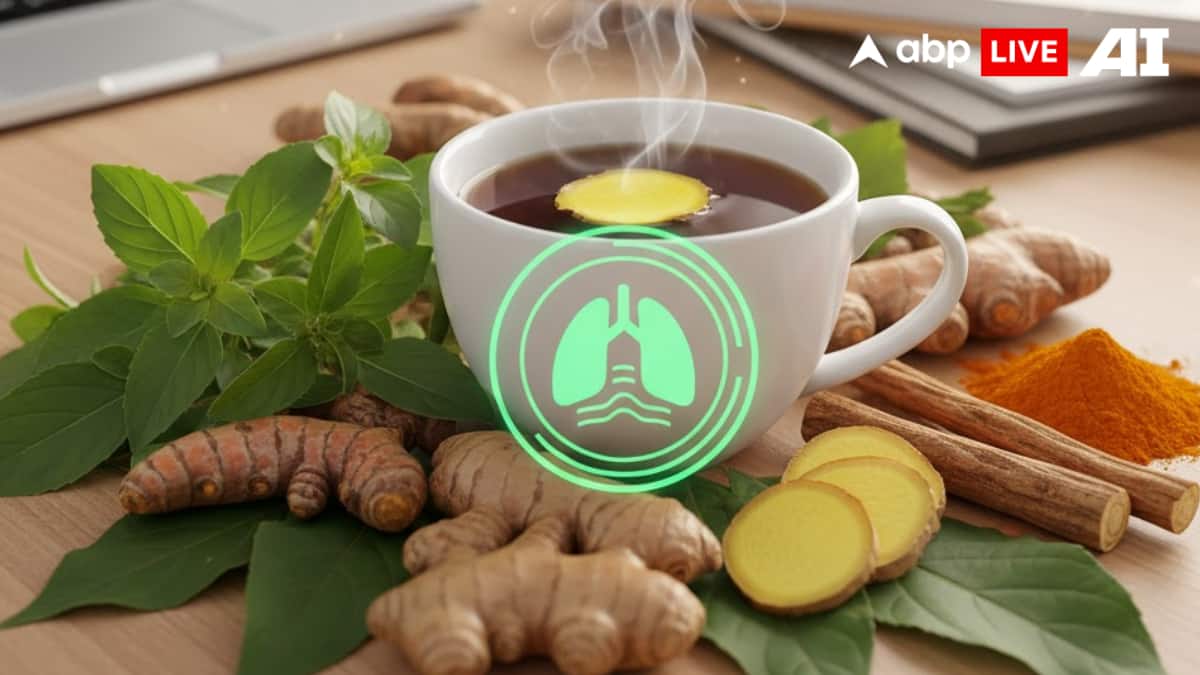
Ayurvedic Herbal Teas That Protect Lungs From Indoor Air Pollution
(Image Source: ABPLIVE AI)
With printers, chemical cleaners, carpets, and recycled AC airflow, pollutants accumulate in offices, even without visible dust. Dr. Yadav affirms, “Herbal teas play a key role in soothing inflamed airways, reducing mucus stagnation, strengthening pranavaha srotas, and helping the body cope with polluted indoor air.”
Among the most supportive herbs, Tulsi stands out for its ability to create a protective respiratory shield. She notes that it is “anti-inflammatory, antimicrobial and anti-allergic,” making it especially effective for those who experience recurring cough, congestion or throat irritation after long hours in AC circulation.
Turmeric, with its golden potency, offers deeper internal protection. According to Dr. Yadav, its curcumin “protects against pollutant-induced inflammation and reduces oxidative stress,” making it an ideal companion for people exposed to micro-toxins daily.
To soothe the bronchi and calm the chest, Yashtimadhu becomes a valuable ally. It “soothes irritated bronchi and relieves spasms and dry cough,” making it perfect for those who feel tightness or dryness after breathing in stale office air.
Ginger brings heat and vitality into the mix. It “clears mucus and boosts circulation,” helping the respiratory channels stay open and active even in cold, dry, air-conditioned environments.
And for those days when the air feels especially heavy, Dr. Yadav recommends Vasaka. Known for its powerful expectorant properties, it is “excellent for smog-season congestion,” offering relief when indoor pollution peaks during winter or crop-burning months.
HR-Safe, Office-Approved Ayurvedic Hacks Nobody Will Notice
(Image Source: ABPLIVE AI)
Most offices prohibit incense, diffusers or visible rituals, but Ayurveda offers subtle adaptations that can be practised discreetly. As Dr. Yadav explains, “Many workplaces prohibit smoke, fragrance diffusers or visible rituals. Ayurveda offers simple, invisible adaptations suitable for office settings.”
These include carrying warm water in a thermos, keeping a copper bottle, using discreet nasya during restroom breaks, keeping a warm shawl for AC exposure, and placing antimicrobial items like neem or clove in office drawers.
These include carrying warm water in a thermos, keeping a copper bottle, using discreet nasya during restroom breaks, keeping a warm shawl for AC exposure, and placing antimicrobial items like neem or clove in office drawers.
The Truth About Essential Oils At Work: Helpful Or Harmful?
(Image Source: ABPLIVE AI)
Ayurveda values aromatics but recommends caution in closed rooms. Dr. Yadav emphasises, “Ayurveda values aromatic herbs but advises careful use of essential oils in closed indoor environments.”
While oils like eucalyptus, lavender and tea tree can be used minimally on personal inhalers or handkerchiefs, others may irritate the lungs or trigger headaches. “Internal consumption of essential oils should never be practiced at work, and should only be done under medical supervision,” she adds.
This mindful use ensures that office-goers receive therapeutic benefits without overwhelming their senses or affecting colleagues.
With rising indoor pollution levels and prolonged AC exposure becoming the norm, Ayurvedic wisdom offers practical, office-friendly solutions that keep energy, immunity and mental clarity intact. Dr. Yadav’s insights underline a simple truth, modern workplaces may challenge the body, but small, consistent adjustments can transform overall wellbeing.
[Disclaimer: The information provided in the article is shared by experts and is intended for general informational purposes only. It is not a substitute for professional medical advice, diagnosis, or treatment. Always seek the advice of your physician or other qualified healthcare provider with any questions you may have regarding a medical condition.]