Welcome to DailyAdda News (“we”, “our”, “us”). By downloading, accessing, or using the DailyAdda News mobile app or website, you agree to the following Terms & Conditions. Please read them carefully.
🔹 1. Use of the App
DailyAdda News provides:
Bengali, Hindi & English news
RSS-based headlines
Short summaries
External links to publishers
Local updates, alerts & information
You agree:
To use the app legally
Not to misuse or interfere with its services
Not to copy, distribute or republish our summary content without permission
🔹 2. Content Sources & Copyright
DailyAdda News shows:
Headlines
Short rewritten summaries
Source credit
Link to original article
We do not claim ownership of original articles from external publishers.
You must access full articles on the publisher’s website. External content belongs to respective copyright holders.
🔹 3. User Conduct
You agree not to:
Harm or disrupt the app
Attempt unauthorized access
Upload harmful material
Scrape data or automate requests
Use the app for political manipulation or spreading misinformation
🔹 4. Third-Party Services
DailyAdda News uses:
External RSS feeds
Third-party news websites
Google AdMob
Analytics services
We are not responsible for:
Accuracy of external content
Availability of third-party websites
Their privacy policies or terms
🔹 5. Notifications
DailyAdda News may send:
Breaking news alerts
Job alerts
Local city updates
Weather warnings
You may disable notifications anytime in device settings.
🔹 6. No Guarantee of Accuracy
News is subject to change. We try to provide accurate updates but:
We do not guarantee 100% accuracy
We are not responsible for errors or delays
Users should verify important news directly from official sources
🔹 7. Advertisements
DailyAdda displays ads through:
Google AdMob
Other ad partners
We are not responsible for:
Content of ads
Actions taken on third-party ad pages
🔹 8. Limitation of Liability
DailyAdda News is not liable for:
Data loss
App downtime
Incorrect or outdated news
Third-party website actions
Financial, personal, or business loss caused by news content
Use the app at your own risk.
🔹 9. Changes to the Service
We may modify:
Features
Categories
App layout
Terms & Conditions
We can also suspend or discontinue parts of the service.
We use cookies to ensure you get the best experience on our website. By continuing to use our site, you accept our use of cookies,
Privacy Policy,
and
Terms of Service.
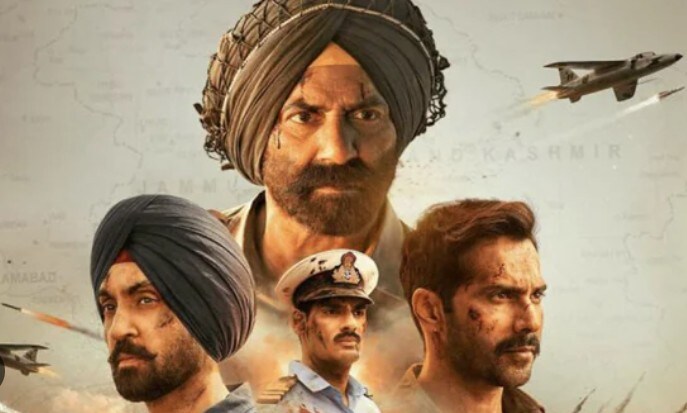
Review: Border 2 has come at a time when Hindi movies embrace jingoism with all their might
Mounted on a grand scale but filmed largely in and around real military locations and installations, Border 2 is a longer, brighter, and more ballistic and variegated replica of the original war drama released in 1997. In tone and texture, however, it isn't the same.
The surface sheen of Border 2 reflects the significant distance that Mumbai's commercial cinema has travelled in terms of filmmaking technique in the 28-year interregnum. It is bolder and louder than Border could ever have been given the times in which it was envisaged and executed.
Yet, all things considered, Border 2 is essentially an extension of what the JP Dutta-directed blockbuster, one of the biggest Mumbai hits of the 1990s, brought to the screen - men at war.
Sunny Deol is the common factor between the two films and, nearly three decades on, he ensures that the spirit that drove Border is kept alive and kicking in the follow-up, a movie that has JP Dutta on board as a producer but is directed by Anurag Singh (Jatt & Juliet, Kesari).
The veteran actor is in his elements, pressing everything he has at his disposal into the service of this patriotism-fuelled exercise designed primarily to remind Indians of the glory that the three arms of the defence forces brought to the nation in a war that it waged within the first quarter century of its Independence.
The strongest support for the lead actor comes from Diljit Dosanjh, who dons the garb of Flying Officer Nirmal Jit Singh Sekhon, posthumous recipient of the Paramvir Chakra after the 1971 India-Pakistan war.
The actor is fortysomething, Flying Officer Sekhon was only 26, but Dosanjh manages to project the sort of youthfulness that serves to paper over the casting discrepancy.
The same cannot however be said of Varun Dhawan, cast as another recipient of India's highest gallantry award, Major Hoshiar Singh Dahiya, famous for his leadership role in the battle of Basantar.
The actor is about the same age as the real-life character he portrays on the screen, but his interpretation of the 1971 war hero errs on the side of faux flash and flourish, which somewhat diminishes the impact of the film's finale.
Those who have seen the Malayalam film, 1971: Beyond Borders, might be inclined to compare Mohanlal's interpretation of a senior Army officer modelled on Major Dahiya. But there really can be no comparison.
Border 2 has come at a time when Hindi movies embrace jingoism with all their might. Although clearly mindful of what might work and what might not in the current climate, the film walks a tightrope that is often in danger of flying off its tether. If it doesn't, it is solely because Border 2 retains some remnants of the principles of yore.
The film has the length of Dhurandhar as well as a bit of its unrelenting and showy bellicosity, but it plants itself somewhere between the ultra-violent spy thriller and the refreshingly moderate Ikkis, a war film that is "anti-war" like all the great war films that have ever been made anywhere in the world.
Border 2 makes a fair first of extolling the exceptional valour of the soldiers it showcases while probing, if only superficially, the vulnerabilities and mental swings that make them human and believable. Separations, bereavements, hopes, fears and misgivings punctuate the drama in which lives are put on the line and heroic deeds are performed in the blink of an eye.
The men who parade across the screen and demonstrate an indomitable spirit possess great courage and fortitude but they are also wracked by doubts and frailties because their lives hang by a thread and they have families that they have left behind with a prayer on their lips.
Deol, playing a fictionalized version of a real-life war hero, has his customary cracks at declamatory screeds aimed at keying up his men, besides arousing fervour among the audience. On both counts, the strategy works reasonably well.
Heightened emotions serve as the spine of a narrative that plays out on land, at sea and in the sky, with men of the Indian Army, Air Force and Navy at their very best as defenders of the borders. But the action that explodes on the screen is interspersed with quieter moments that allow the spouses and mothers of the soldiers, and the men themselves, to give vent to their feelings.
Border 2, like its predecessor, tempers the truculent with the timorous, with the balance markedly tilted towards the former. But that is to be expected from a three-hour-plus film about a military conflict that took place 55 years ago that has to factor in contemporary mass susceptibilities.
When the Bangladesh liberation struggle triggered the India-Pakistan war in 1971, and also when JP Dutta made Border two decades and a half later, India was a different place, a place that had space for a degree of nuance, when acts of battlefield bravery did not have to resort to unbridled bombast to register itself on the collective consciousness of the audience.
On the acting front, Sunny Deol and Diljit Dosanjh are the bulwarks that stand firm even when the film strays into stretches that appear a tad inconsistent.
Ahan Shetty, playing an Indian Navy officer, stands in for his father Suniel Shetty (who portrayed a Rajput royal and Border Security Force captain in Border), but finds himself in a high-profile mix of actors who threaten to overshadow him. It is no mean achievement that he holds his own.
The female characters are a secondary presence. There are quite a few - Mona Singh, Sonam Bajwa and Anya Singh among them - but none gets the sort of play that Rakhee, Tabu and Pooja Bhatt did in Border.
Director of photography Anshul Chobey captures the visual sweep with striking competence but one cannot but feel the absence of Ishwar Bidri, the cinematographer who imparted remarkable fluidity to the 1997 war drama (as he did to JP Dutta films of the 1980s - Ghulami, Yateem, Batwara and Hathyar).
It is inevitable for a movie this long to occasionally sink into tedium. Border 2 does. But it has just enough ammunition in its armoury to be able to keep blitzkrieg going no matter what.