Even if the JF-17 may seem like a popular choice for many nations, interoperability is not exportable, nor is effective warfighting capability.
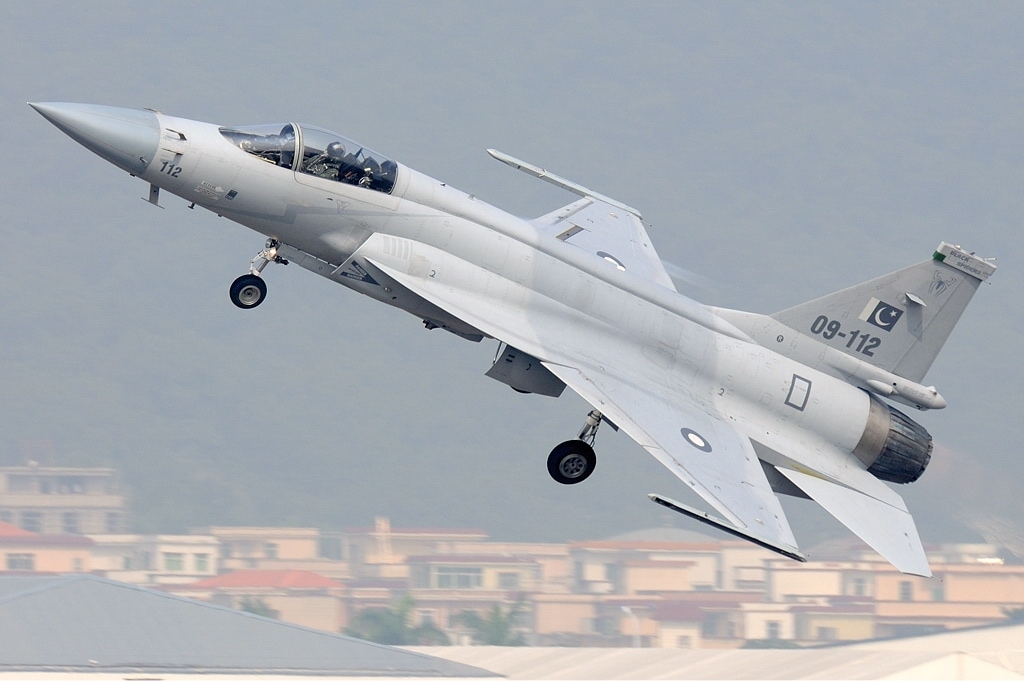
The recently concluded Singapore Air Show featured a display of diverse regional air power. Islamabad brought to the show its JF-17 'Thunder' Block III, a Sino-Pakistani multirole fighter jet. Jointly developed by the Pakistan Aeronautical Complex (PAC) and the Chengdu Aircraft Corporation (CAC) of China, the JF-17 has undergone multiple changes, from its Block I version debuting in the early 2000s, to the Block III iteration of today getting inducted into the Pakistani Air Force (PAF) by 2022. Block III can be classified as a 4.5-generation multirole combatant that mitigates to a great extent, Pakistan's dependence on the West, as well as Russia. Simultaneously, it enhances military collaboration between Islamabad and Beijing, considering that the JF-17, together with J-10CEs and PL-15Es, forms an interoperable air defence ecosystem of Chinese-origin equipment for deployment by the PAF.
Where It Started
In its early stages, PAF's fighter jet programme was driven by a need to reduce dependence on the West for fighter jets and replace its ageing fleet of Nanchang A-5C bombers, Chengdu F-7P/PG interceptors, and Dassault Mirage III/5 multirole aircraft. In the 1980s, Islamabad and the American company Grumman launched a Sabre II project, to collaboratively upgrade the PAF's Chengdu F-7 fleet. However, the project was abandoned following the imposition of sanctions on China in 1989, and on Pakistan following its 1998 nuclear tests. And so, in 1995, Pakistan and China signed a Memorandum of Understanding (MoU) to jointly develop what was then known as the 'Super 7'.
Prototype production commenced in September 2002, with the first jet rolling out in May 2003. Its maiden flight took place in late August 2003 at Chengdu, and by March 2004, the flight test programme had completed 20 missions. It then became the 'Joint Fighter-17' (JF-17) to reflect the collaborative nature of the programme. The '17', interestingly, came from an attempt to depict the JF-17 as a successor to the US's F-16.
Per data from the Pakistan Aeronautical Complex in Kamra, Punjab, the industrial model for the JF-17 is a shared production arrangement where PAC Kamra holds a 58% work share of the airframe, focusing on sub-assemblies, structural parts, and final assembly, while China's CAC provides the remaining 42%, primarily involving the avionics and engine integration. The first PAC-produced aircraft was handed over to the PAF in November 2009.
Evolution of the Blocks
The JF-17 Block I established the jet's multirole identity, featuring a glass cockpit with digital avionics and the ability to deploy beyond-visual-range (BVR) missiles like the SD-10. However, it lacked advanced electronic warfare (EW) suites and air-to-air refuelling.
The Block II variant addressed these limitations by introducing an in-flight refuelling probe, strengthened wing roots for additional carriage, and updated avionics to handle a wider array of air-to-surface munitions. By 2017, the programme also introduced the JF-17B, a dual-seat variant designed for both lead-in fighter training (LIFT) and enhanced operational roles such as electronic warfare or strike coordination.
The Block III variant deploys certain technologies typical in 4.5-generation fighters. At its core is the NRIET/ CETC KLJ-7A Active Electronically Scanned Array (AESA) radar, which potentially possesses the ability to track 15 targets simultaneously, and the capacity to engage four. This is paired with an electronic warfare suite.
The primary powerplant for the JF-17 fleet has historically been the Russian-origin Klimov RD-93 turbofan engine, a derivative of the RD-33 that powers the MiG-29. For the Block III, Pakistan has opted for the upgraded RD-93MA, which likely provides an enhanced thrust.
The contemporary jet hosts seven hardpoints, which can carry 3,600 kg of ordnance. The integration of the PL-15E BVR missile and the JF-17, together with a suite of other systems imported from China (such as the J-10CE jet, the PL-10 missile, and the HQ-16 and HQ-9P ground-based air defence systems), is the combination one is likely to see in the PAF's Air Defence operations going forward.
Combat Validation
The PAF first utilised the JF-17 in combat in 2010 against the Tehrik-i-Taliban Pakistan (TTP) in South Waziristan. Between 2014 and 2017, the aircraft was extensively used in anti-terror operations in North Waziristan, deploying both guided and unguided munitions to destroy militant infrastructure. In June 2017, a JF-17 demonstrated its air-to-air capability by shooting down an intruding Iranian military drone near the border in Balochistan. In early 2024, the JF-17 participated in Operation 'Marg Bar Sarmachar', conducting precision airstrikes against Baloch groups in Iran's Sistan and Baluchestan province.
Against India, the JF-17 was deployed by the PAF after the Balakot airstrike. At the time, the jets utilised REK MK-83 bombs to strike Indian ammunition depots and headquarters from standoff ranges. Then, in Pakistan's May 2025 operation, 'Bunyan Al-Marsus', the PAF combined varied Chinese-origin systems against India, including the JF-17.
Abroad, the Turkish 'Anatolian Eagle' military exercise has acted as a testing laboratory for the JF-17s. In 2019, for example, five JF-17s conducted 389 sorties, undertaking offensive and defensive counter-air missions against Turkish "Aggressor" aircraft. These exercises utilised an Air Combat Manoeuvring Instrumentation (ACMI) system to provide real-time visualisation of tactics.
In 2021, the JF-17 flew alongside Qatari Rafales, and in February 2025, the fleet appeared at Saudi Arabia's 'Spears of Victory' exercise. This deployment included air-to-air refuelling and combat missions against fighters from the UK, US, and France.
Most importantly, the 'Shaheen' series of exercises with the Chinese People's Liberation Army Air Force (PLAAF) has focused on large-force employment and integrated electronic warfare. These drills, such as Shaheen IX in 2020 and Shaheen X in 2024, have seen the PAF attempt to imbibe China's "system of systems doctrine", networking the JF-17 with Chinese KJ-500 AWACS and ground-based HQ-9 air defence systems.
An Interesting Market
As middle military powers emerge, there is also an increasing desire among nation-states to acquire systems that are cost-effective and do not come with end-use monitoring or alliance requirements - as may be the case with American systems. Combined with a certain price advantage of the JF-17 against the American F-16 or the Gripen, as well as PAF's reasonable show of force in its participation in various exercises and operations involving the JF-17, there seems to have tentatively emerged a market for the jet.
Azerbaijan, for example, signed a USD 4.6 billion deal in 2024 for 40 JF-17 Block III fighters with Pakistan. This deal includes munitions, training, and, reportedly, even a logistics support package. Subsequently, Baku unveiled its first JF-17s during its "Victory Day" parade in November 2025.
Then, in December 2025, the Libyan National Army (LNA) finalised a deal valued at approximately USD 4 billion for 16 JF-17 Block III jets and 12 Super Mushshak trainers. Despite the UN arms embargo, the deal provided LNA leader Khalifa Haftar's military position a boost. The Nigerian Air Force received three JF-17s in 2021 and has used them effectively in counter-insurgency operations against Boko Haram. There is speculation that Bangladesh, Indonesia, Iraq and Saudi Arabia might also consider buying the JF-17s, though there is no official confirmation from their governments.
Publicity Fuel
And yet, despite this emerging market, the JF-17 is neither the most efficient jet, nor a perfect alternative to established market dominators. In fact, while it is co-produced with China, Pakistan does not possess the same defence industrial base. PAC Kamra currently produces fewer than 20 aircraft per year, a rate primarily calibrated for domestic fleet replacement. With a backlog of over 45 export units and a domestic need to replace 250 more legacy aircraft, the facility faces a significant capacity crunch. Even some of those who have purchased the jet - such as Myanmar - had to ground their fleet of previous Block iterations because of technical malfunctions and low endurance issues.
Further, the dependency on Russian engines remains a point of criticism. Concerns about heat management and engine reliability have been various, and the impact of sanctions on Russian businesses has made overhauling the RD-93 fleet cumbersome. The RD-93 has a short service life of 2,200 hours compared to the 4,000 hours of its Indian counterparts' engines. While China has offered the WS-13 Taishan engine as a more "unsanctionable" alternative, it remains unproven in combat and has not yet been adopted for the PAF's mainline fleet.
Pilots have also reported radar resolution cell issues with the KLJ-7 AESA radar, in which the system struggles to distinguish closely flying targets, potentially affecting situational awareness in dense combat environments. If the KLJ-7/7A AESA radar has poor accuracy, maintenance issues, and limited range, it would prevent the full use of PL-15 missiles without AWACS support.
The noteworthy takeaway for India from the latest use case of the JF-17s is the operational value of an integrated air-defence suite. A clear-eyed assessment, however, makes it clear that even if the JF-17 may seem like a popular choice, interoperability is not exportable, nor is effective warfighting capability. The hindrances faced by PAC Kamra and their erstwhile customer, Myanmar, are a case in point.
Disclaimer: These are the personal opinions of the author