Letters sent to foreign powers and the United Nations by a civil society group in India against the National Green Tribunal's (NGT) order "seek to delegitimise and internationalise an order passed by a statutory judicial body of the country".
Letters sent to foreign powers and the United Nations by a civil society group in India against the National Green Tribunal's (NGT) order "seek to delegitimise and internationalise an order passed by a statutory judicial body of the country", a memorandum submitted today to the Prime Minister's Office (PMO) and the Ministry of Home Affairs (MHA) has said.
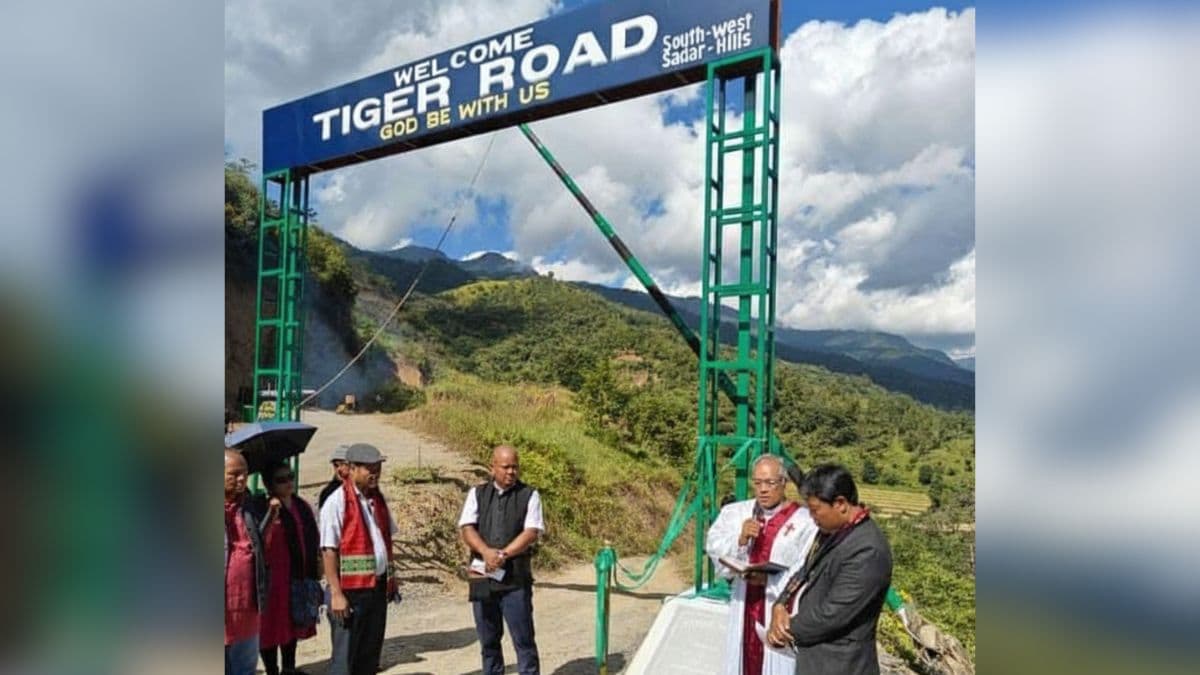
The NGT's eastern zone bench in Kolkata on December 23 ordered to stop work on a road paved illegally through the forests in Manipur. The Manipur government has said it had not approved or sanctioned any such road, locally referred to as 'German Road' and at certain stretches as 'Tiger Road'.
'German' and 'Tiger' are nicknames of Kuki insurgents.
"... By portraying a judicial decision as 'institutional violence,' 'collective punishment,' and as grounds for foreign intervention, these communications undermine India's sovereignty and the authority of its constitutional and quasi-judicial institutions. Such actions risk setting a dangerous precedent whereby internal judicial processes are selectively escalated to foreign governments and multilateral bodies," the civil society organisation Meitei Heritage Society (MHS) said in the memorandum given to the PMO and the MHA.
"It is a matter of public record that Chin Kuki Zo organisations and individuals have, in the past, approached the United Nations, the US, Israel, and other foreign actors - masquerading as tribal bodies by using misleading tribal names while it is Kuki Chin Zo organisation - with fabricated one-sided narratives regarding the Manipur crisis..." the MHS said.
It alleged there is a geopolitical context to the matter and also destabilisation efforts by external forces.
"These developments cannot be viewed in isolation. They must be examined within the broader regional and geopolitical context, including statements by exiled Prime Minister of Bangladesh, Sheikh Hasina, referring to foreign interests seeking strategic military footholds in the region - widely believed to be among the reasons for toppling her Government. Additionally, recent remarks and activities by Bangladeshi political and non-governmental actors have indicated intentions to destabilise India's northeastern states," the MHS said.
Letters To UN And US Embassy Against NGT Order
The memorandum came after the Kuki Alliance for Nampi Awakening Movement (KANAM) sent letters to the UN Environment Programme's executive director, UN High Commissioner for Human Rights Volker Turk, and the US embassy in New Delhi.
"A blanket construction ban has been imposed in Kuki-Zo hill areas despite ongoing ethnic violence, loss of access to National Highways, and the absence of viable alternatives... Environmental protection must be grounded in balance, proportionality, and human survival. What is occurring in Manipur represents the weaponization of environmental language to facilitate isolation and attrition of a vulnerable population. KANAM urges UNEP to acknowledge that environmental principles cannot be invoked to justify policies with foreseeable lethal humanitarian consequences," KANAM secretary Hmingthangkima Sailo said in the letter to the UN Environment Programme (UNEP) executive director.
In the letter to Volker Turk, among other points, KANAM said the NGT issued the order despite the green court being fully aware or at the very least constructively aware that Kuki-Zo areas no longer have safe or reliable access to National Highways and depend almost entirely on hill connectivity.
The Kuki civil society group then made a serious allegation in its letter to the US embassy in New Delhi.
"KANAM urges the United States government to closely monitor this situation and to recognise that judicial and administrative institutions in India are being used to impose collective punishment under the cover of environmental regulation. The foreseeable result is civilian suffering and potential loss of life," it said.
Highway Reality
Meitei civil society organisations have called the KANAM's claim of no access to highways a farce to keep the pot boiling in order to apply pressure on the Centre for creating a separate 'Kukiland' by dividing Manipur.
They said it is the Meiteis who cannot access National Highways that pass through Kuki villages where two dozen armed groups that are under the suspension of operations (SoO) agreement have the final say in decision-making.
The Churachandpur-based Kuki Zo Council (KZC), which represents the civilian side and also works closely with the Kuki insurgent groups under the SoO agreement, has said there is no "unrestricted access or free movement" between Meitei and Kuki settlements.
The National Human Rights Commission (NHRC) in December had ordered the police and civil authorities in Manipur's Kangpokpi district to give an action-taken report on a complaint about denial of safe passage through National Highway-2, which connects the state capital Imphal with Dimapur in neighbouring Nagaland.
The Meitei civil society organisation in its memorandum to the PMO and the MHA requested for taking note of the letters by KANAM and other Chin Kuki Zo groups addressed to foreign governments and international organisations, and to issue appropriate directions to the MHA and other relevant ministries for a comprehensive policy and security review.
"Pursue a permanent, just, and lawful solution to the Manipur crisis that protects all indigenous communities and preserves Manipur and India's territorial integrity," the MHS said.
Brief Case History
The NGT said it ordered the Manipur chief secretary on August 20, 2025 to give a preliminary report on the allegations made by the applicant, COCOMI, within four weeks. The NGT on September 4 extended the deadline by four weeks, and on October 27 by another two weeks.
The green court in its latest order on December 23 gave four more weeks after the chief secretary said responses given by the forest divisions in four of the six districts involved in the matter have to be re-verified before putting the information on record.
The next hearing is on February 2, 2026.
Following protests by the Foothill Naga Coordination Committee (FNCC), the Manipur government held a meeting with the civil society organisation's representatives in Imphal on August 8, 2025.
A post-meeting statement said it was clarified that the state government had not approved or sanctioned any such roads as pointed out by FNCC.
"Necessary legal action will be taken after verifying the status of such illegal constructions/naming, if any on ground, will not be permitted," a statement signed by leaders of four tribal organisations of the FNCC and Manipur home secretary N Ashok Kumar said.
The areas that 'German/Tiger Road' pass are not far from some designated camps of Kuki insurgent groups that signed the SoO agreement, extended for a year on September 8.